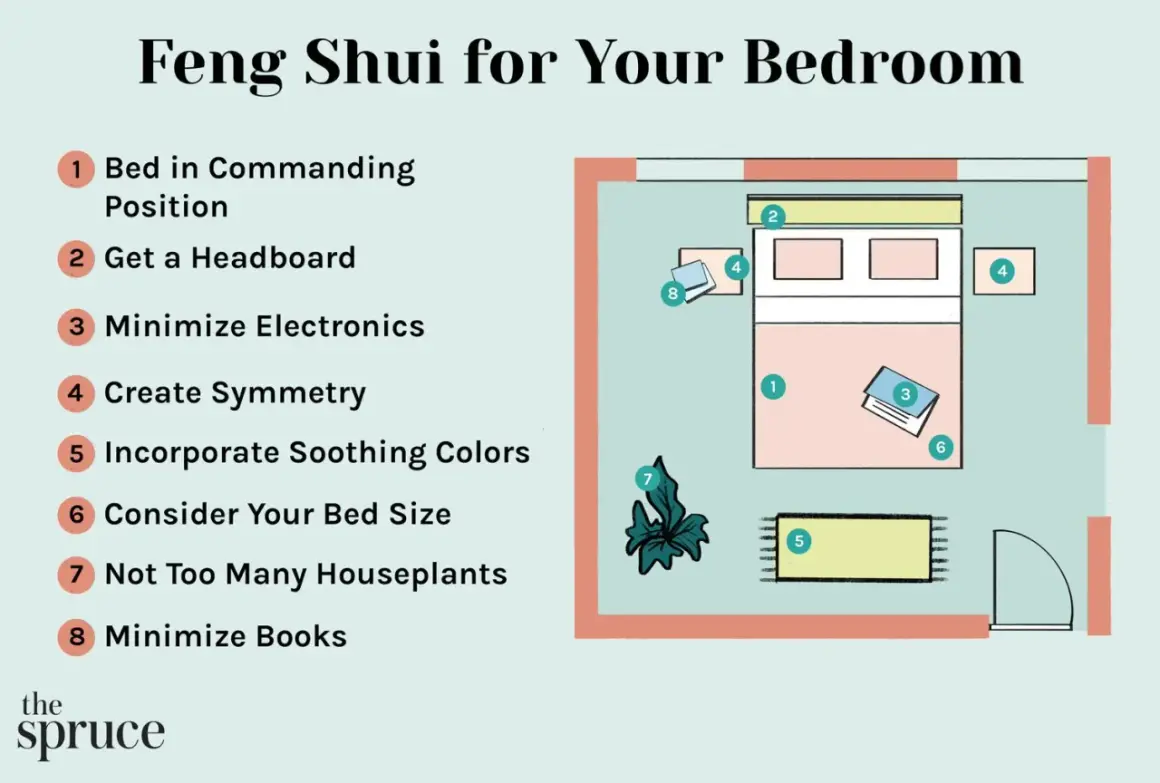
The placement rules that matter most
- Put the bed where you can see the door without sleeping in a direct line with it.
- Give the headboard a solid wall and, if possible, keep the bed off the window wall.
- Avoid mirrors facing the mattress, overhead beams, and visual clutter near the bed.
- Use paired furniture, closed storage, and calm bedding to make the room feel settled.
- Treat compass directions as a secondary refinement, not the first fix.
Start with the command position
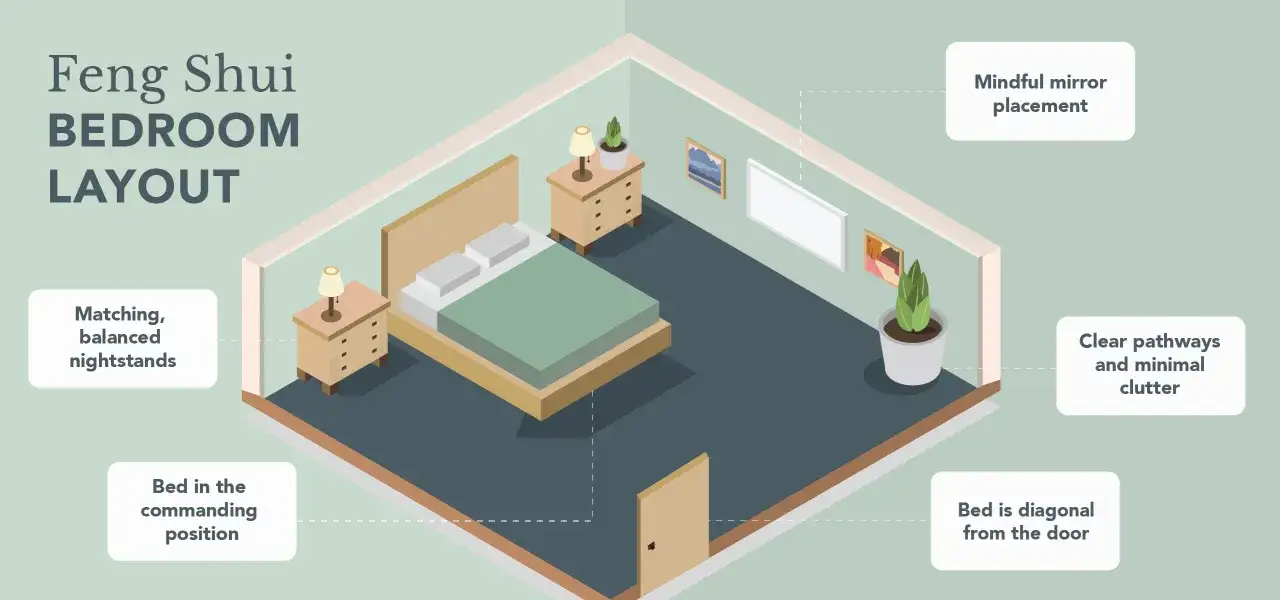
The command position is the layout principle I reach for first. It means you can see the bedroom door from the bed, but the bed is not directly in line with the opening, and the headboard sits against a solid wall. That placement gives the room a quieter feel because your body is not constantly reacting to the door path. Chi, the Feng Shui term for life energy, tends to feel less unsettled when the sleeping area has that kind of visual security.
- Stand where the bed would go and look for the best diagonal or offset view of the door.
- Choose the wall that gives the headboard the most solid backing.
- Leave at least one clear path to each side if the room can support it.
- If the door and window compete, protect the door sightline first and the window second.
If I have to choose, I would rather keep the bed slightly off-center than place it head-on with the door. Once that base is right, the next job is removing the placements that quietly work against sleep.
Remove the placements that make a bedroom feel exposed
I do not treat every rule as a hard law, but certain setups reliably make a room feel less restful. The table below shows the problems I see most often and the simplest correction I would try first.
| Problem setup | Why it feels off | Better move |
|---|---|---|
| Bed directly in line with the door | The sleeping position feels exposed and easy to interrupt. | Shift the bed off-axis so the door is visible, but not aimed straight at the mattress. |
| Headboard under a window | There is less sense of backing, and the sleep zone can feel visually restless. | Move to a solid wall if you can. If you cannot, use a taller upholstered headboard and lined curtains. |
| Mirror facing the bed | It adds movement and reflection to a space that should be visually calm at night. | Turn the mirror away, relocate it, or cover it during sleep if it is fixed in place. |
| Beam or sloped ceiling above the pillow | The overhead pressure can make the bed feel cramped. | Move the bed if possible. If not, place the pillow away from the lowest point and simplify the ceiling area visually. |
| Headboard against a bathroom wall | Noise and moisture make the room feel less grounded. | Relocate the bed or add a heavier headboard and better sound insulation if the wall cannot change. |
When a bad layout cannot be fully avoided, I look for the smallest meaningful correction. A heavier headboard, blackout drapes, or a cleaner path around the bed will not rewrite the room, but they can turn a poor setup into a livable one. That leads to the part many people skip: the furniture around the bed has to reinforce the placement, not fight it.
Let the furniture do some of the work
A bedroom usually feels better when the pieces around the bed are doing calm, repetitive jobs. I like a solid headboard, two nightstands when the room can support them, and lamps that sit at roughly the same visual height. That symmetry is not about perfection; it simply stops one side of the room from feeling unfinished.
- Choose a real headboard. Wood or upholstered both work well because they read as support.
- Use paired surfaces if possible. Matching nightstands are ideal, but even two similar-height pieces can balance the room.
- Keep storage closed. Open baskets and exposed piles pull attention away from rest.
- Leave the underside of the bed calm. If you use under-bed storage, keep it minimal and contained.
- Reduce electronics at arm’s reach. A charging station across the room is usually better than a glowing screen beside your pillow.
- Pick bedding that feels grounded. Breathable sheets, a simple duvet, and one or two accent layers usually work better than a crowded stack of pillows.
If the room is small, I would simplify the decor before I forced extra furniture into it. You do not need every surface filled for the bedroom to feel complete. The tricky part is that real bedrooms are rarely ideal, so the next question is how to work with awkward dimensions without breaking the logic of the layout.
Make awkward rooms work without forcing them
Small bedrooms and odd layouts are where Feng Shui advice gets practical. If the ideal position does not fit, I choose the compromise that protects sleep first and styling second. In a tight room, one clean solution is better than three half-fixes.
| Layout problem | Best compromise | What I would avoid |
|---|---|---|
| Bed under a window | Use a solid headboard, lined drapes, and the lowest, most stable bed frame that works for the room. | Leaving the pillow exposed to drafts, bright light, and visual clutter. |
| Room too narrow for both sides of the bed | Keep one side open, use wall-mounted lighting, and preserve about 24 to 30 inches of usable walkway if possible. | Cramming in oversized nightstands that make the room hard to move through. |
| Door, closet, and bed all compete for the same wall | Offset the bed so it can see the door and still leave a practical route to the closet. | Blocking storage access, which creates daily friction that outweighs any placement ideal. |
| Studio or shared room | Use a rug, a screen, or a low shelf to define the sleeping zone without closing the room off completely. | Overloading the room with dividers, extra mirrors, and decorative clutter. |
I also pay attention to visual weight. A low-profile frame can make a small room feel less crowded, while a tall upholstered headboard can make a difficult setup feel more supported. That also explains why compass direction matters less than many people think.
Treat compass direction as a refinement
Different Feng Shui schools assign different meaning to east, west, north, and south, and that is why you will see conflicting advice online. Some systems use personal favorable directions, while others focus almost entirely on placement and room balance. In my view, direction matters only after the bed is physically in a good location. If a compass-based rule would push the bed into a worse layout, I would ignore the direction and protect the room’s basic comfort.
| Priority | What I would solve | Why it comes first |
|---|---|---|
| Placement | Door line, wall support, and window exposure | These affect how safe and settled the bed feels every night. |
| Furniture balance | Headboard, nightstands, lighting, and storage | These shape the room’s visual stability and day-to-day usability. |
| Compass direction | Personal or school-specific orientation | Helpful only once the layout already works in practical terms. |
If you follow a specific practitioner or tradition, direction can matter more, and I would respect that. For most readers, though, the room works better when the bed feels protected and easy to live with before anything else is optimized. Once those layers are in place, the last step is keeping the whole room from drifting back into clutter.
The version of the room I would choose first
If I had to set up a bedroom from scratch tonight, I would start with a bed on a solid wall, slightly off the door line, with a headboard that feels anchored and a clear path on at least one side. I would keep the mirror away from the mattress, remove visual noise near the pillow, and choose bedding that feels calm rather than overdecorated.
- Keep the bed visible from the door, but not directly aimed at it.
- Use the strongest wall in the room for the headboard.
- Keep the sleep zone free of mirror reflections and overhead pressure.
- Use simple, balanced furniture instead of filling every corner.
- Fix the layout first, then refine with color, texture, and accessories.
That is the version of the space that usually feels calm, usable, and easy to maintain. The best feng shui bed placement is the one that balances protection, access, and simplicity without making the room hard to live in, and that is the rule I would keep even when the room is imperfect.